
Another Eden Begins Named Locations Across Three Eras
The towns, forests, and cities Studio Prisma actually publishes — not a fake dungeon GPS.
Players searching “Another Eden Begins map” usually want the named places, not a fan-drawn grid. This page is that list. Studio Prisma, Nintendo, and Steam agree on three eras — present, future, antiquity — and on a short set of locations that kick the story into motion. The world and eras page is the calendar. This page is the street names. Neither page invents chest coordinates or unpublished dungeon layouts.
The campaign is a single-player time-travel JRPG. You move freely between eras once the story opens them. The six-chapter demo is built to start in the present and reach the future city. Antiquity is a full-game horizon. If a guide tells you to farm a later original-game continent inside Begins, send it back with Begins versus the original.
Baruoki — home in 300 AD
Aldo and Feinne live in Baruoki, an idyllic village under the Kingdom of Miglance. Official story copy is blunt: they enjoy a peaceful life until the Beast King takes Feinne. Everything after that sentence is a pursuit. Baruoki exists so the kidnapping lands. Talk to people. Learn field movement and symbol encounters while the streets still look like a town.
Baruoki is not the whole present. It is the door. Knights, paladins, and the prisma crystal economy belong to the wider Kingdom of Miglance around it. Bertrand’s official blurb calls him the former knight once known as the Shield of Miglance. Anabel is heir to the first great paladin. Helena is the steel-clad queen who reaches across prejudice. Those companion lines are how the present era announces itself: swords, shields, priests, and a village you are about to lose.
Moonlight Forest — the throw
Aldo pursues Feinne into the Moonlight Forest. Official English story text: following a fierce battle with a beast, he is sent through a tear in spacetime and finds himself in a world 800 years in the future. That forest is the first real dungeon stretch of the opening. Expect paths, symbol fights, and a turning-point beast encounter. This wiki will not post fabricated HP bars for that fight. Keep a healer thought in the four-slot line and treat Another Force as a tool, not a panic button. See party building.
The Moonlight Forest is also the thesis of the whole campaign. You are not touring a theme park. You are displaced. When the tone shifts from village to sky city, the map has already done its job.
Kingdom of Miglance — prisma and 300 years of rule
Official English world copy: 300 AD, 300 years since the founding of the Kingdom of Miglance, the time of Aldo. Human society relies heavily on prisma, a form of crystalized energy, and the same paragraph asks whether humanity has the right to claim it. Japanese copy names prisma as プリズマ and ties daily life to those crystals.
Miglance is the political frame around Baruoki. It is also the dairy culture behind at least one published meal: Wright Flyer Studios’ AnotherMealBegins short describes Ooey-Gooey Cheese Fondue as a product of Miglance’s long-standing dairy culture in times of peace. That is flavor for the crafting and cat catalog page, not a recipe table. Do not expect a full Miglance overworld atlas inside chapters 1–6.
Elzion — the Shining City, 1100 AD
After an incident that left the planet’s soil ruined and radiated, humanity escaped to the skies and built the Shining City of Elzion. Official English copy calls the floating metropolis a beacon of peace that still casts a bitter shadow. Japanese copy centers daily life on 曙光都市エルジオン.
This is where the party starts looking like a party. The well-known Part 1 opening brings in Amy and Riica during the future stretch the demo walkthrough treats as expected. Cetie works for the Elzion Judicial Bureau. Renri is an elite investigator with her own sense of justice. Suzette is the self-made princess of darkness. Future-era places lean toward hunters, androids, and bureau halls rather than Miglance steel.
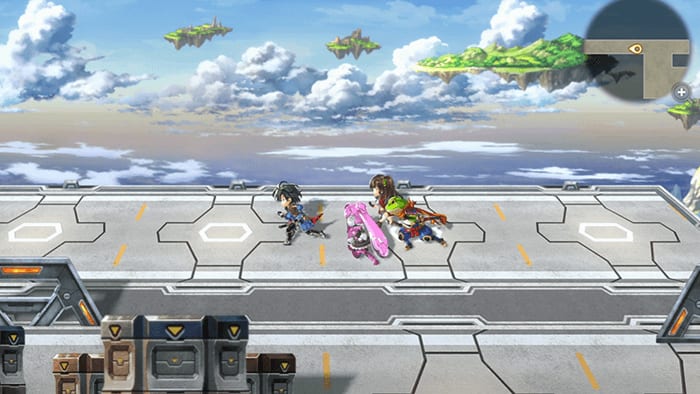
Official screenshots of Elzion show denser streets, banners, and a minimap that actually has walkways. If Baruoki taught you to talk to people, Elzion teaches you to read a skyline. The six-chapter trial is expected to reach this city. It is not expected to finish every side street. Leave a clean save at a chapter boundary so save transfer can carry story progress and character stats into the 17 September campaign.
Antiquity — 20,000 BC and King Palsifal’s tower
Official English copy: humans of this era walk hand in hand with nature, protected by the four great elementals. Somewhere, the troubled King Palsifal builds a tower to carry out an experiment wholly unnatural. Japanese copy names the Palsifal dynasty (パルシファル王朝) and a giant tower built for a certain study.
The tower is the image to remember. It is the opposite of Elzion’s floating city: earth, spirits, and a king who wants something the elements did not offer. The demo covering chapters 1–6 is not a full antiquity tour. Do not hunt the tower inside the trial and then assume this wiki omitted a map. Antiquity is a full-game era. When it opens, era-based crafting is the system that cares — a recipe that wants antiquity ore is a recipe you cannot finish in Baruoki.
How to use this list in play
- Install from Getting Started and play the opening as a route, not as a checklist of hidden chests.
- Learn the command window on present-era roads before you treat Elzion as a sandbox. Controls covers field movement without inventing a PC key table.
- Encounter, character, and kinship quests often belong to a person and a place. Skipping the place skips the person.
- New Game+ sends you back through these calendars with kept strength. The named locations are the board those ten-plus endings play on.
- Optional DLC allies still recruit through encounter quests gated by story progress. Buying a pack does not drop them into Baruoki on the title screen.
What we will not publish
No unverified dungeon maps. No chest GPS. No “optimal era order” table. No import of the original mobile game’s later continents as if they were Begins DLC. Begins is a premium campaign with a closed 19-person roster plus optional DLC packs. Geography in the live-service original is a different product.
Nintendo’s Switch 2 Edition page lists 4K support and up to 60 FPS. Location geometry does not change between Switch and Switch 2; fidelity does. The $5 Upgrade Pack is a license, not a second map. File sizes live on editions.
If you only remember five names, remember Baruoki, the Moonlight Forest, Miglance, Elzion, and Palsifal’s tower. Every other street in Another Eden Begins hangs off those five. For dates and the final trailer that sold this map on 2 September 2026, keep updates and official links nearby.
Frequently Asked Questions
Quick answers to the most common questions.
Does the demo include all three eras?
Official trial notes cover main story chapters 1–6. The expected opening runs Baruoki through the Moonlight Forest into Elzion. Antiquity is a full-game era. See the demo walkthrough.
Is there an in-game world map?
Official screenshots show a minimap HUD in towns. This wiki does not publish a fan-drawn atlas. Walk the field; symbol encounters sit on the map, not on invisible dice.
Where is prisma used?
Official present-era copy says Miglance society relies on prisma, a crystalized energy. Treat it as world texture until the in-game help screen says otherwise.
Can I visit King Palsifal's tower in the demo?
Do not expect a full antiquity tour in chapters 1–6. The tower is published as an antiquity image for the complete campaign.
How is this different from the world page?
The world and eras page is the three calendars. This page is the named towns, forest, city, and tower those calendars contain.